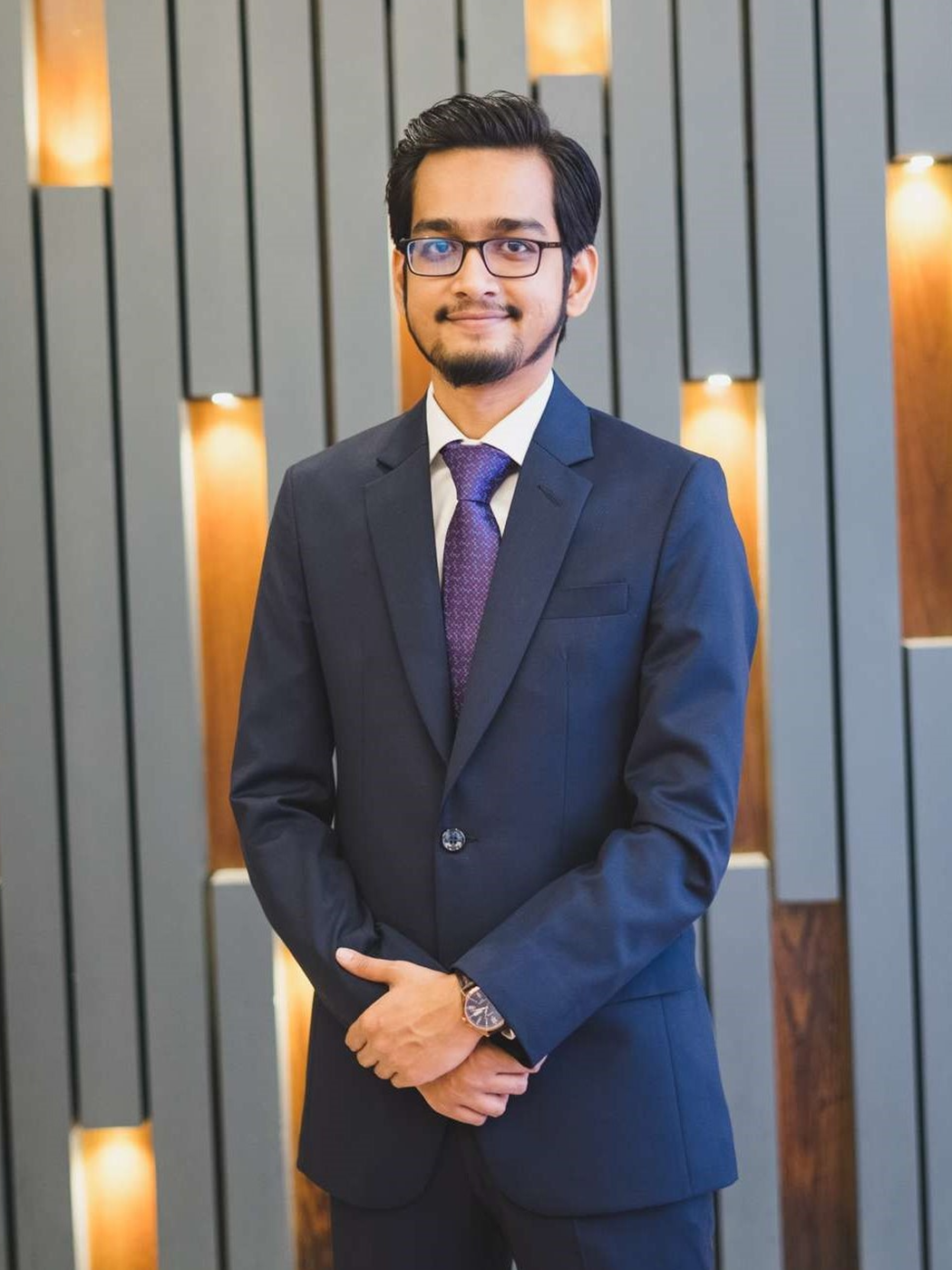
Md. Sabbir Ahmed
Senior Lecturer - Full Time
sabbir.ahmed@bracu.ac.bd
Websites
https://www.bracu.ac.bd/about/people/md-sabbir-ahmedAddress
CSE Department
4th floor, Room No # 4M107,
Brac University,
Kha 224 Bir Uttam Rafiqul Islam Avenue,
Merul Badda, Dhaka, Bangladesh
Md. Sabbir Ahmed is a Senior Lecturer in the Department of Computer Science and Engineering at BRAC University, Dhaka, Bangladesh. His academic work spans Data Science, Machine Learning, Explainable Artificial Intelligence (XAI), Computer Vision, and Human-Computer Interaction (HCI), with a focus on developing trustworthy, interpretable, and human-centered intelligent systems. He has contributed to multiple peer-reviewed international publications and actively collaborates on interdisciplinary research initiatives.
In addition to his research and teaching, he is actively engaged in academic leadership, research community building, and student mentorship. He contributes to undergraduate thesis supervision, faculty and student engagement initiatives, and the coordination of academic and professional programs involving students, faculty members, and external partners. Through his work, he is committed to strengthening research culture and fostering an inclusive, forward-looking academic environment.
Journals
Ahmed, M. S., Tazwar, M. T., Khan, H., Roy, S., Iqbal, J., Rabiul Alam, M. G., Hassan, M. R., & Hassan, M. M. (2022). Yield response of different rice ecotypes to meteorological, agro-chemical, and soil physiographic factors for interpretable precision agriculture using extreme gradient boosting and support vector regression. Complexity, 2022. https://doi.org/10.1155/2022/5305353
Conferences
Rofi, I. B., Eshita, M. M., Chakma, A., Ahmed, M. S., Haque, S. T., & Noor, J. (2025, April). The good, the bad and the ugly: The opportunities, challenges and mitigation strategies of young Indigenous social media users of the Chittagong Hill Tracts in Bangladesh. In Proceedings of the 2025 CHI Conference on Human Factors in Computing Systems (pp. 1–22). https://dl.acm.org/doi/full/10.1145/3706598.3713268
Mollah, M. S. A., Niloy, D. B., Ruhani, H. K., Tasnin, R., Dofadar, D. F., & Ahmed, M. S. (2025, August). Automated selection of optimal cricket team using machine learning. In 2025 IEEE 7th Symposium on Computers & Informatics (ISCI) (pp. 280–285). IEEE. https://doi.org/10.1109/ISCI65687.2025.11167451
Bhuiyan, H. J., Mozumder, M. F., Khan, M. R. I., Ahmed, M. S., & Nahim, N. Z. (2025, March). Enhancing bidirectional sign language communication: Integrating YOLOv8 and NLP for real-time gesture recognition and translation. In 2025 11th International Conference on Computing and Artificial Intelligence (ICCAI) (pp. 168–174). IEEE. https://doi.org/10.1109/ICCAI66501.2025.00035
Ayshi, I. J., Haque, M., Anis, S. M., Tasnim, N., Moontaha, M., Ahmed, M. S., & Hossain, M. I. (2024, December). Comparative analysis of deep learning and OBIA on satellite images for forest cover monitoring. In 2024 27th International Conference on Computer and Information Technology (ICCIT) (pp. 599–603). IEEE. https://doi.org/10.1109/ICCIT64611.2024.11022550
Bin Rofi, I., Eshita, M. M., Ahmed, M. S., & Noor, J. (2024, December). Identifying influences: A machine learning and explainable AI approach to analyzing social media addiction resulting from academic frustration. In Proceedings of the 11th International Conference on Networking, Systems, and Security (pp. 128–136). https://dl.acm.org/doi/full/10.1145/3704522.3704529
Trisha, A. S., Rofi, I. B., Eshita, M. M., Biswas, J., & Ahmed, M. S. (2023, December). Content, consumption, and productivity: An empirical analysis of compact streaming and reel content’s effects on the productivity of today’s emerging generation. In 2023 15th International Conference on Software, Knowledge, Information Management and Applications (SKIMA) (pp. 181–186). IEEE. https://doi.org/10.1109/SKIMA59232.2023.10387365
Tanu, M. D., Faisal, S. F., Majumder, S., Sristy, M. R., Paul, R., Hossain, M. I., & Ahmed, M. S. (2023, November). Hybrid steganography: A multi-layered framework for hybrid text and image concealment enhanced by AES and LSB techniques. In 2023 16th International Conference on Security of Information and Networks (SIN) (pp. 1–6). IEEE. https://doi.org/10.1109/SIN60469.2023.10474670
Biswas, J., Mridha, A. A., Hossain, M. S., Trisha, A. S., Ahmed, M. S., & Hossain, M. I. (2023, July). Interpretable credit card fraud detection using machine learning leveraging SHAP. In 2023 IEEE 6th International Conference on Electronic Information and Communication Technology (ICEICT) (pp. 1206–1211). IEEE. https://doi.org/10.1109/ICEICT57916.2023.10245439
Ahmed, M. S., Iqbal, K. N., & Alam, M. G. R. (2023, January). Interpretable lung cancer detection using explainable AI methods. In 2023 International Conference for Advancement in Technology (ICONAT) (pp. 1–6). IEEE. https://doi.org/10.1109/ICONAT57137.2023.10080480
Tazalli, T., Aunshu, Z. A., Liya, S. S., Hossain, M., Mehjabeen, Z., Ahmed, M. S., & Hossain, M. I. (2022, December). Computer vision-based Bengali sign language to text generation. In 2022 IEEE 5th International Conference on Image Processing Applications and Systems (IPAS) (pp. 1–6). IEEE. https://doi.org/10.1109/IPAS55744.2022.10052928
Ahmed, M. S., Afrose, S., Adnan, A., Khanom, N., Hossain, M. S., Mehedi, M. H. K., & Rasel, A. A. (2022, December). Comparative analysis of interpretable mushroom classification using several machine learning models. In 2022 25th International Conference on Computer and Information Technology (ICCIT) (pp. 31–36). IEEE. https://doi.org/10.1109/ICCIT57492.2022.10055555
Dofadar, D. F., Abdullah, H. M., Khan, R. H., Rahman, R., & Ahmed, M. S. (2022, September 13). A comparative analysis of lumpy skin disease prediction through machine learning approaches. 4th IEEE International Conference on Artificial Intelligence in Engineering and Technology, IICAIET 2022. https://doi.org/10.1109/IICAIET55139.2022.9936742
Joy, S. K. S., Dofadar, D. F., Khan, R. H., Ahmed, M. S., & Rahman, R. (2022, July 16). A comparative study on COVID-19 fake news detection using different transformer based models. 2022 IEEE Symposium on Industrial Electronics and Applications, ISIEA 2022. https://doi.org/10.1109/ISIEA54517.2022.9873797
Ahmed, M. S., Rahman, R., Hossain, S., & Mohammad, S. A. (2021). Brain tumor prediction by analyzing MRI using deep learning architectures. 2021 Third International Conference on Inventive Research in Computing Applications (ICIRCA), 1493–1498. https://doi.org/10.1109/ICIRCA51532.2021.9545077
Ahmed, M. S., Rahman, R., Arefeen, Z. R., Alam, A., & Tahreen, M. (2021). Effort to mitigate malaria via early detection using hybrid machine learning architectures. 31st International Conference on Computer Theory and Applications, ICCTA 2021, 155–159. https://doi.org/10.1109/ICCTA54562.2021.9916630
Hossain, S., Rahman, R., Ahmed, M. S., & Islam, M. S. (2020). Pneumonia detection by analyzing Xray images using MobileNET, ResNET architecture and long short term memory. 2021 6th International Conference on Inventive Computation Technologies (ICICT), 60–64. https://doi.org/10.1109/ICCTA52020.2020.9477664
Academic Leadership & Institutional Roles
Academic Appointments
CSE437 – Data Science: Coding with Real-World Data (Theory)
CSE421 – Computer Networks (Theory)
CSE110 – Programming Language I (Theory)
CSE111 – Programming Language II (Theory)
CSE472 – Human-Computer Interface (Laboratory)
CSE427 – Machine Learning (Laboratory)
CSE422 – Artificial Intelligence (Laboratory)
CSE471 – Systems Analysis and Design (Laboratory)
CSE421 – Computer Networks (Laboratory)
CSE330 – Numerical Methods (Laboratory)
CSE110 – Programming Language I (Laboratory)
CSE111 – Programming Language II (Laboratory)
CSE101 – Introduction to Computer Science (Laboratory)
Accepting
As: |
|
Level: |
Undergraduate & Postgraduate |
Type: |
|